Gemini 4 Argon: Google's new frontier model for coding, knowledge work, and cyber defense
Google announces its frontier model, designed to sustain deep reasoning across long and complex workflows. What its arrival means for Spanish organizations currently deciding on their AI strategy.

On September 30, 2026, Google announced Gemini 4 Argon, its new frontier model designed to sustain deep reasoning across long and complex workflows (official announcement).
Thousands of Google employees are already using it in their daily work, and it will gradually roll out to developers, businesses, and end users, starting with paid API customers and Google AI Ultra subscribers. Here is what its arrival means for Spanish organizations currently deciding on their AI strategy.
- 1 million output tokens, compared to the previous 64K.
- Leader in Vals Index (economic impact weighted by U.S. GDP), DeepSWE v1.1 (77.9%) and CWE-bench v1 (68%, tied for first place).
- Restricted initial rollout via Fairwind Program for trusted cybersecurity defenders.
- Google hasn't given a date yet for developers and companies.
What is Gemini 4 Argon and why does it matter?
Gemini 4 Argon is the Google DeepMind's current frontier model: the capacity ceiling the company has announced to date. It is built explicitly for three areas of professional use:
- Real-world software engineering, not just example snippets, but entire codebases.
- Business knowledge work: legal, finance, audit, processes.
- Cyber defense: autonomous discovery, validation, and patching of vulnerabilities.
Two technical changes distinguish it from previous generations. The first is the 1-million-token output window, compared to the 64K of the 3.8 generation. In practice, this means that Argon can generate hundreds of thousands of tokens in a single reasoning trajectory, without losing the thread during long, multi-step tasks.
The second is that it has been trained to sustain long chains of reasoning without straying from the objective, a problem that has limited the practical utility of LLMs in real-world enterprise workflows. If you want the full conceptual framework explaining why this matters, we cover it in our Guide to what artificial intelligence is.
What stands out about the advertisement is that Google is starting with its own cases.Argon is already being used by thousands of Google employees, and the internal results set the tone for what we can expect.
What Argon is already doing within Google
Before reaching external customers, Argon passed through the most rigorous filter: Google's internal engineering. Three concrete examples from the announcement:
Optimization of quantum algorithms
Researchers on the quantum computing team use Argon to optimize the resources (qubits × logic gates) of subroutines that act as bottlenecks in key applications.
It beat the published baseline by 40% in minutes.Data center-scale memory efficiency
A team of Argon agents analyzed profiling telemetry from Google's entire fleet, and autonomously identified and applied memory optimizations.
Over 300 TiB freed up · estimated savings of 500 TiB to 1 PiBMassive legacy code migrations
Argon agents are migrating C/C++ codebases to Rust within Google: from tens of thousands of lines in core libraries (re2, libgav1) to over 800,000 lines in the Fuchsia Zircon kernel.
In the case of libgav1Argon, Google's open-source video decoder, rewrote 32K lines of SIMD code in safe Rust through iterative, profiling-guided experiments.
2.7× faster than the previous Rust port, with identical output and close to the optimized C++ version.An important detail: these critical migrations go through rigorous automated and manual auditing, emulation testing, and review prior to deployment to productionArgon does not replace the quality process; it accelerates it.
Frontier-level coding beyond autocomplete
In external benchmarks, Argon sets a new state of the art in DeepSWE v1.1, which measures performance on real, long-horizon software engineering tasks—not just snippets, but end-to-end tasks involving actual repositories. These figures should be viewed with caution: they are benchmarks published by Google—currently without independent verification—and Argon does not lead in every test (for instance, it trails other models in FrontierSWE or Terminal-Bench 4.0).
For technical teams in Spain, what matters is not the percentage, but rather what enables it as a class of tractable problem:
- Legacy migrations: COBOL or legacy Java to modern stacks, monoliths to microservices.
- Massive refactors without losing tests or functionality.
- Technical debt audits about codebases that no human can wrap their head around.
- Performance rewrites guided by profiling, not intuition.
Subject to the same condition that defines internal migrations: Argon is an accelerator, not a replacement for disciplined software engineering.
Knowledge work: legal, finance, and business processes
Beyond coding, Argon's positioning extends to what Google calls enterprise knowledge workThe benchmarks highlighted in the announcement are those that most closely resemble actual work in business areas. These are the official comparisons published by Google:

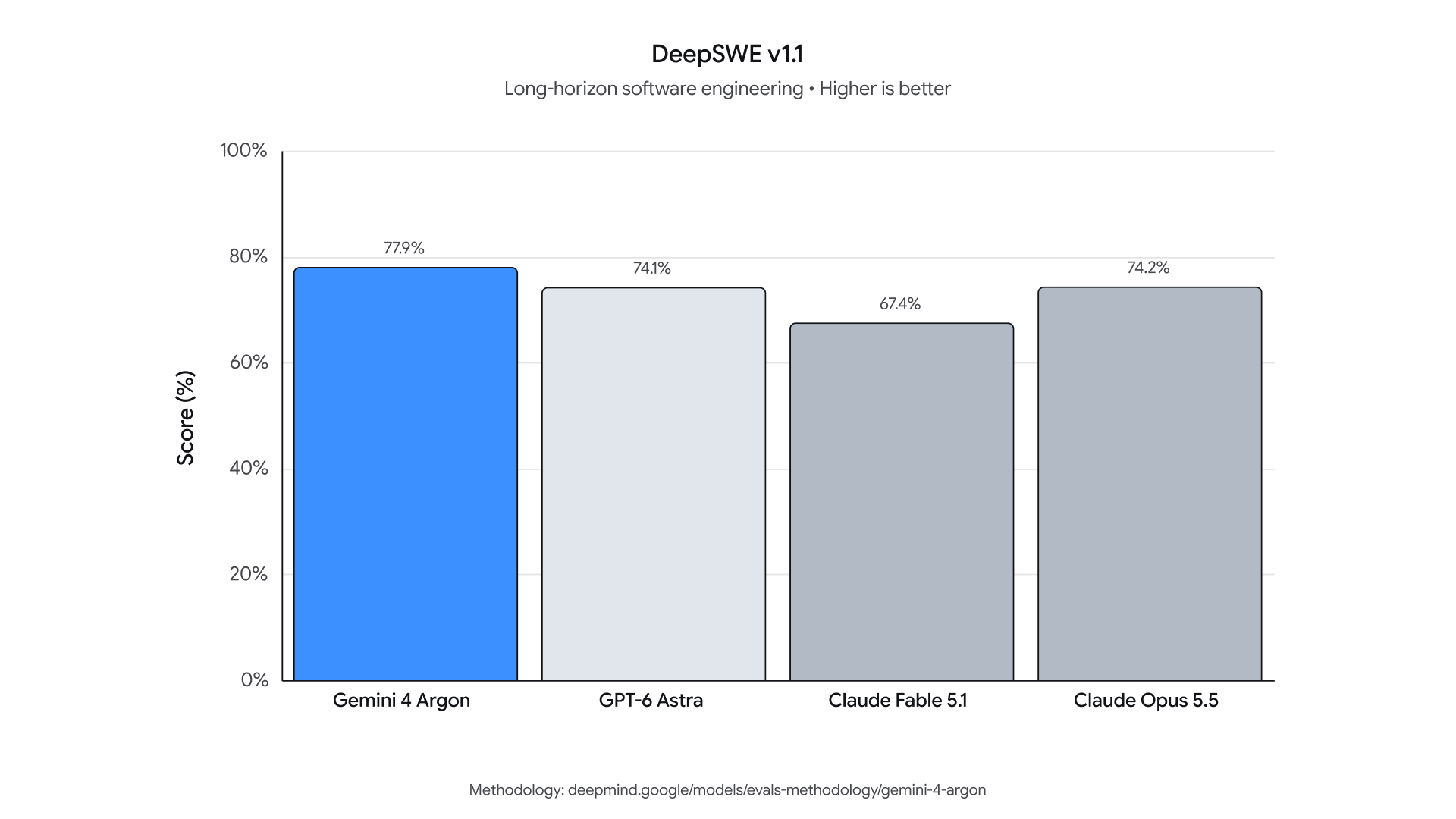


Official Google charts. Source: Google.
The block LVBench It is less obvious but highly useful in day-to-day business operations: analyzing meeting recordings, auditing corporate training, and reviewing visual evidence during due diligence or compliance processes.
The block legal and financial ...is the most disruptive. Argon does not replace lawyers or analysts, but it changes the marginal cost of tasks such as mass contract review, multi-scenario financial risk analysis, due diligence on extensive documentation, or the preparation of materials for committees.
Cyber-defense: the front where Argon is already in production
This is the area where Argon is furthest along commercially. The first rollout wave is exclusively for trusted cybersecurity defenders via the Fairwind Program from Google DeepMind.
The distinguishing capability is that Argon can autonomously find, validate, and patch critical software vulnerabilitiesFor trusted defenders and internal Google teams, the model is released without cybersecurity guardrails, enabling the full utilization of its frontier capabilities.
The most prominent public use case is Wiz and its "Scan for Good" initiative: a program that protects critical public infrastructure at no cost by detecting and remediating high-risk exposures. In an early demonstration, Argon identified a critical vulnerability in healthcare software used by hospitals worldwide—one that exposed sensitive personal information and had been overlooked by previous frontier models. At The Cloud Collective we are authorized Wiz reseller in Spain: If you want to apply this detection and remediation capability to your own cloud environment, we can help you.
Beyond CWE-bench, Argon substantially outperforms 3.8 Flash Cyber in Google's internal tests and in Wiz's black-box penetration testing benchmark, which evaluates the ability to analyze live web systems without access to source code.
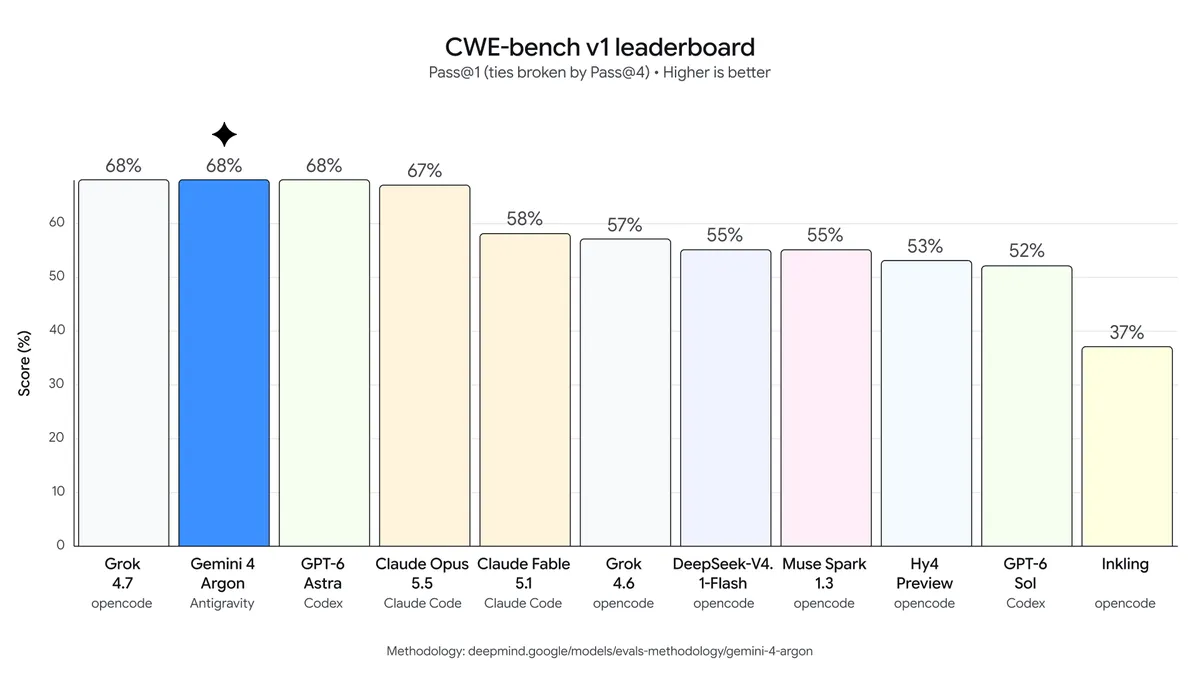
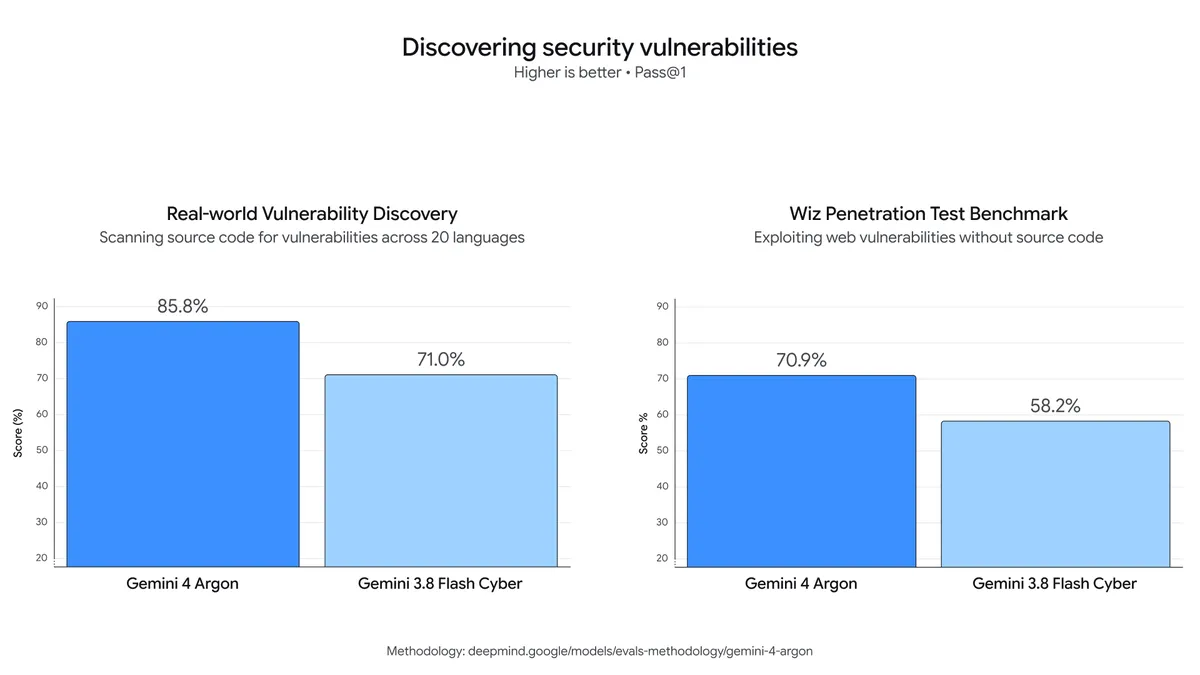
Official Google charts. Source: Google.
For Spanish companies, this connects directly to our analysis regarding Google Cloud Enterprise security: The threat landscape is becoming professionalized with offensive AI, and so is defense.
Safeguards prior to the general rollout
Google is aware that a model with these capabilities requires a phased rollout. The announcement details four pillars of safeguarding that they are reinforcing ahead of general availability:
Defense against malicious use
The model rejects requests for use in cyberattacks or the production of CBRN (chemical, biological, radiological, nuclear) weapons, while preserving legitimate dual-use scientific research. Techniques for monitoring the model's internal activations are being improved to detect attempts at misuse.
Resilience against prompt injection
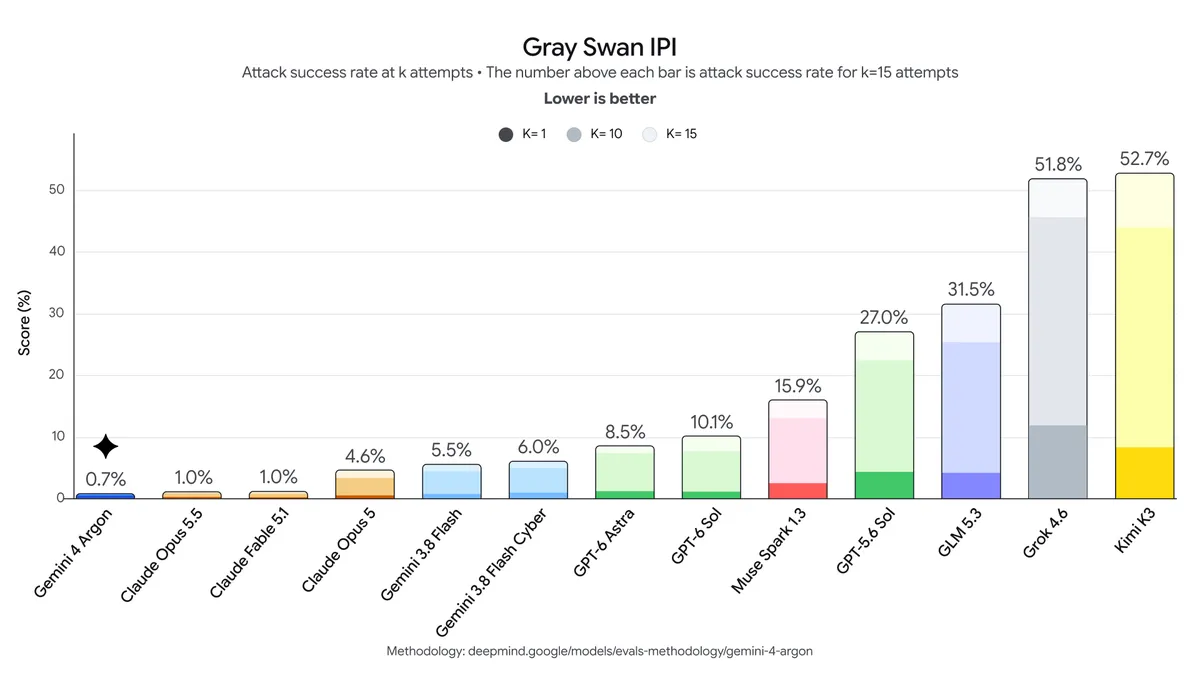
Argon is Google's most robust model against indirect prompt injections, where malicious instructions are slipped into the context to hijack behavior. It leads the Gray Swan Indirect Prompt Injection benchmark.
Misalignment monitoring
Google deploys mitigations that monitor Argon's chain of reasoning and actions, halting execution if the model deviates from the user's intent.
Sealed sandboxed environments
Before initiating high-risk training or evaluations, following Google DeepMind's agent safety roadmap.
Google is also participating in the U.S. government's voluntary process for pre-release access to frontier models.
Roadmap: When will Argon reach companies in Spain?
Google has not announced specific dates, but it has the rollout order:
Google has not announced any dates. Our assessment, based on previous launches, is that general availability in Agent Platform and Gemini Enterprise It will arrive in a matter of months rather than years, but it is best not to plan around a specific date until Google announces it—including for Spain and the EU.
What to do in the meantime: two concrete steps
Waiting for Argon to become available without preparing the organization is waste the interval. Two actions we recommend starting today:
Preparing the organization with Gemini Enterprise
Gemini Enterprise is Google's agent platform for the enterprise: it connects Gemini models with your data from Google Workspace or Microsoft 365 , with governance and spend control. It is the most efficient starting point so that, when Argon becomes available, the model lands on fertile ground rather than in an organizational void:
- Governance and permissions already configured for your corporate data.
- Usage habits established within teams: searching company data, agents such as Deep Research or Data Insights, and automated day-to-day workflows.
- Prompts and templates tailored to your business.
- Adoption metrics to identify where AI is generating real value.
Without this foundation, a frontier model like Argon is like handing a Formula 1 car to someone without a driver's license.
Building infrastructure for frontier models with Agent Platform
For teams that want to go beyond the conversational assistant, the next step is to build customized agents connected to internal systems: CRM, ERP, data warehouses, internal documentation. This is designed based on Gemini Enterprise Agent Platform, the Google Cloud agent platform where models like Argon are deployed via API with the security, compliance, and governance controls required by an enterprise environment.
When Argon becomes available via API , teams that already have agents built on Agent Platform will be able to switch the underlying model without rebuilding the architectureThose who don't will then start from scratch.
Prepare your company for the next generation of Google AI.
Step 1: Get started with Gemini Enterprise today—up and running in 7 days with our Quick Setup. Step 2: Build your first agents with Agent Platform.
The Cloud Collective is Google Cloud Premier Partner . We support you through both steps.
Talk to us →Frequently Asked Questions
Google has not provided a specific date, only the rollout order, which we detail in the roadmap section. It is expected to arrive for Agent Platform and Gemini Enterprise , but there are no dates yet for Spain or the EU.
No. Gemini Enterprise is the agent platform (connectors, agents, and governance), while Gemini in Workspace is the AI integrated into Gmail , Docs, or Meet. Argon is a model; it is expected to be usable via API within the Agent Platform and, eventually, within Gemini Enterprise for tasks requiring long-context reasoning.
The introductory rate is $2 per million input tokens and $10 per million output tokens, with a 95% discount on cached input tokens. After the introductory period, the rates rise to $4 and $20, respectively; Google has not specified when this period ends. For many use cases, this is offset by the increased capacity for long tasks. Check the current rates in Google's official documentation before sizing a project.
Fairwind is designed for trusted cybersecurity defenders: cybersecurity companies, critical infrastructure security teams, and institutional bug bounty programs. It is not a general early-access channel for enterprises. The path for enterprises is to wait for the rollout on Agent Platform and Gemini Enterprise .
3.8 Flash Cyber is a cybersecurity-specialized model from the previous generation. Argon delivers substantial improvements in vulnerability discovery across complex codebases (covering 20 programming languages in Google's internal benchmark) and in black-box penetration testing on live web systems. Furthermore, Argon is a general-purpose model: it also leads in coding, legal, finance, and long-form video comprehension.
Not on the visible horizon. Not even within Google: its own migrations involving critical codebases are audited, tested via emulation, and reviewed before deployment. Argon is a powerful accelerator for long, repetitive tasks, but human judgment remains the filter that decides what goes into production.