Gemini 4 Argon: what it is and what changes for businesses on Google Cloud

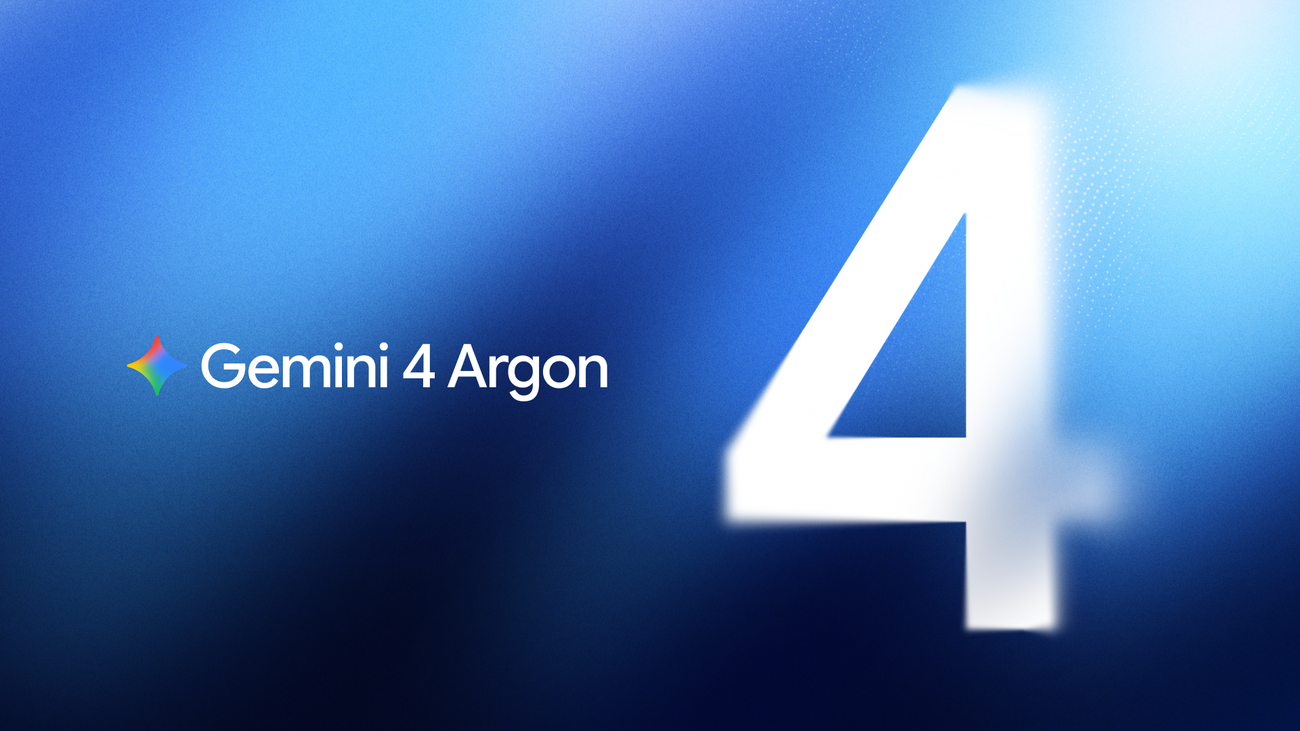
Google has launched Gemini 4 Argon, its new frontier model, making it available to businesses on Google Cloud as of October 13, 2026. This is no minor update to the Gemini family: Argon is designed for long, multi-step tasks—the kind that previously required hours of professional effort and which earlier models tended to leave unfinished.
It is Google's frontier model for complex enterprise work. It maintains context across long, multi-step tasks, analyzes documents combining text, tables, charts, and images, and is available in Gemini Enterprise , the Gemini Enterprise Agent Platform, and via API using the identifier.
At The Cloud Collective we explain what Argon offers, where it can be used, how much it costs, and what you should consider before incorporating it into your processes.
What Gemini 4 Argon offers compared to previous models
Argon’s breakthrough lies not so much in providing better answers to isolated questions as in completing entire tasks. Google has trained it to combine depth and precision: it maintains the thread throughout lengthy tasks and applies specialized knowledge at every step.
Long, multi-step task
Argon can read extensive and diverse documentation and transform it into a single, structured output based on those sources. It can synthesize conclusions from multiple documents into a single response, analyze data series over time, and draft legal, financial, or executive documents with greater rigor.
More reliable behavior in critical tasks
For a technology leader, this is likely the most significant change. According to Google, Argon is trained to:
- Respect the limits of the system in which it operates.
- Report negative results honestly, rather than filling in the gaps.
- Request confirmation before executing irreversible steps.
- Notify when unable to find something or complete a task.
These properties enable the transition from an assistant that makes suggestions to an agent to which work can be reliably delegated.
Four areas where Gemini 4 Argon makes a difference
Delegating the heaviest work
Teams already using Gemini to answer questions or draft documents can now assign it in-depth tasks: reports that cross-reference dozens of sources, analyses of extensive technical documentation, or reviews that previously took days. The result is finished, usable work—not just a first draft that needs to be redone.
Accurate and verifiable results in finance and legal
In regulated sectors, an approximate calculation is not enough. Argon is designed to ensure that calculations and data extraction are accurate, repeatable, and verifiable:
- Finance: automation of multi-step accounting reconciliations, spreadsheet formulas, and variance analysis, with high fidelity in references and formulas.
- Legal: review of case law and regulatory documentation to extract verified citations and key precedents.
According to Google, Argon leads the Vals Index—which measures economic impact on work in finance, programming, legal, and tax—and Harvey’s Legal Agent Benchmark, which focuses on legal research and drafting. While these are third-party evaluations, Google selects which benchmarks to report; use them as a reference and validate the model with your own cases before making decisions.
Build and launch products faster
Argon is designed for complex development projects from start to finish: breaking down goals, tracking progress, and modifying multiple files simultaneously. Google has tested it on its own tools with concrete results:
- The team behind the Agent Development Kit (ADK)—Google’s open-source framework for building agents—left Argon working autonomously overnight within an automated testing environment. The optimizations it discovered, which have already been incorporated into the public repository, reduce in-memory session preparation time for long sessions by 40% and accelerate cold imports by 21%.
- Google engineering teams using Argon in Google Antigravity have increased agent-generated code submissions by more than 35% and reduced code rollbacks by nearly a third.
- Using Argon, the Chrome team completed an architectural refactoring that affected hundreds of files, finishing in weeks a task that would have taken months.
Industrial optimization with AlphaEvolve
Beyond application code, AlphaEvolve—Google’s agent for discovering and optimizing algorithms—uses Argon to improve performance in real-world enterprise workloads: factory production planning, logistics, video game code acceleration, and chip design. For industrial and distribution companies, this represents one of the most promising applications: optimization problems that are currently solved using fixed rules or extensive manual effort.
More protection for your code and your business
In cybersecurity, Argon has a clearly defensive approach:
- Blocks offensive tasks, such as penetration testing or vulnerability exploitation.
- Find and fix vulnerabilities using CodeMender—Google's tool for this purpose—or by integrating it into your own security environment. In the CWE-Bench v1 vulnerability remediation benchmark, it achieves a 68% success rate, tying for first place.
- It offers better resistance to indirect prompt injection—attacks that hide malicious instructions within emails, documents, or web pages read by the model. It leads the Gray Swan Indirect Prompt Injection benchmark, where the attack success rate drops to 0.7% after 15 adaptive attempts.
This last point is especially important if you plan to connect agents to your email, document management system, or web sources: it is precisely the attack surface that most concerns security teams.
Where can Gemini 4 Argon be used?
Argon arrives via the three standard channels of the Google ecosystem:
| Where | For whom | How |
|---|---|---|
| Gemini Enterprise | Employees and business teams | Web, desktop, and mobile applications, alongside the new universal Gemini agent |
| Gemini Enterprise Agent Platform | Technical teams building agents and applications | API with enterprise-grade governance and security |
| Gemini API , Google AI Studio, and Google Antigravity | Developers | Model identifier gemini-4-argon |
For an enterprise, the typical combination is Gemini Enterprise for users and Agent Platform for custom integrations. This allows the same model to be leveraged across both layers, with a unified security and governance framework. You can consult the technical integration documentation at the Gemini Enterprise Agent Platform model guide.
How much does Gemini 4 Argon cost?
API access is billed based on token consumption. According to the official announcement on the Google Cloud blog, the list prices are:
| Period | Input (per million tokens) | Output (per million tokens) |
|---|---|---|
| Introductory price (until November 30, 2026) | 2 USD | 10 USD |
| Standard price (starting December 1, 2026) | 4 USD | 20 USD |
During the launch period, cached input tokens are discounted by 95%. These prices apply to API access. Regarding Gemini Enterprise —which is licensed on a per-user basis—Google does not specify in the announcement which editions include Argon or what the associated quotas are; please verify this before preparing a quote.
Three practical recommendations for controlling spending:
- Don't use Argon for everything: It is the model for complex tasks; for classification, short summaries, or simple answers, a lighter model from the Gemini family is usually more cost-effective.
- Leverage the context cache: ideal for workflows that repeatedly reuse the same documents or regulatory instructions throughout the day.
- Measure the cost per task, not per token: A frontier model that solves a complex task on the first try, without retry loops, can end up being cheaper than a low-cost model that requires constant human oversight and multiple attempts.
Note: Prices are subject to change. Always consult the official Google Cloud pricing page before sizing a project.
What to consider before adopting Gemini 4 Argon
Based on our experience implementing Generative AI projects on Google Cloud For Spanish companies, these are the points worth reviewing before taking the step:
Region and data residency
Check the regions where Argon is available on Agent Platform and whether it meets your data residency requirements. If your organization needs to keep data in Europe due to digital sovereignty policies or GDPR compliance analysis, configure the connection to corporate data sources (such as Google Drive or other document management systems) within the European Union (EU) multi-region.
European AI Act: what applies now and what has been postponed
The Digital Omnibus on AI (EU Regulation 2026/1744, of July 2026) has postponed part of the timeline for the European AI Regulation, but not everything. It is worth making a distinction:
What applies now:
- General application from 2 August 2026. This date has not been postponed.
- Transparency obligations under Article 50. If an agent using Argon interacts with people or generates synthetic content, you must disclose this. There is a brief transitional period for content labeling regarding systems that were already on the market prior to that date.
- New practices prohibited as of December 2, 2026, such as systems that generate non-consensual intimate images or videos of identifiable persons, or child sexual abuse material.
What has been postponed:
- High-risk systems under Annex III, such as personnel selection, human resources, or credit assessment: until 2 December 2027.
- High-risk systems listed in Annex I that are integrated into regulated products: until 2 August 2028.
In other words, the postponement does not leave room for everything. If you are designing workflows with Argon in regulated areas, incorporate transparency and governance into your roadmap right now.
Human supervision of irreversible tasks
Having the model request confirmation before irreversible steps is a great help, but it does not replace a process design with clear control points. Define which actions an agent can execute independently and which require mandatory approval.
Validation using your own data
Public evaluations are for reference only. Before deploying Argon to production, compare it with your current model using a representative set of your own tasks, measuring quality, time, and cost.
Migration from earlier models
If you already have applications based on earlier Gemini models, Google is releasing a developer guide with API conventions and migration steps, and the Gemini 4 Argon model card ...along with its specifications and limits. Review instructions, token limits, and tool-use behavior before switching the model in production. Two details from the model card worth keeping in mind when sizing: the combined input and output context window reaches up to 1 million tokens, and the model's knowledge cutoff is March 2026.
How The Cloud Collective helps you with Gemini 4 Argon
At The Cloud Collective , Google Cloud Premier Partner based in Barcelona, we work exclusively with the Google ecosystem. With the arrival of Argon, we help companies to:
- Identify which use cases justify a frontier model and which are better addressed by more general-purpose models.
- Expand Gemini Enterprise so that business teams can leverage Argon from day one.
- Build agents on the Gemini Enterprise Agent Platform using the ADK, securely connected to your data repositories and with granular permissions within the EU.
- Design governance and security, including protection against indirect prompt injection and strict compliance with the European AI Act.
- Measure and optimize consumption-based costs so the project scales efficiently and without billing surprises.
Frequently Asked Questions
It is Google's frontier model for complex enterprise work, available since October 13, 2026. It is designed for long, multi-step tasks, the analysis of extensive documents, and precision work in finance, legal, development, and cybersecurity.
Via API , the introductory price is $2 per million input tokens and $10 per million output tokens until November 30, 2026. Starting December 1, 2026, the price changes to $4 and $20, respectively.
In Gemini Enterprise for business teams, in Gemini Enterprise Agent Platform for building agents and applications, and via the Gemini API , Google AI Studio, and Google Antigravity using the identifier gemini -4-argon.
No. Argon blocks offensive tasks such as pentesting or vulnerability exploitation. It is defense-oriented: finding and fixing vulnerabilities using CodeMender or your own security environment.
Conclusion
Gemini 4 Argon confirms the direction Google has been charting for months: shifting from assistants that merely respond to agents that complete the work. Its ability to sustain long-running tasks, its cautious approach to irreversible actions, and its resistance to prompt injection make it a strong candidate for critical processes. The key lies not in adopting it as quickly as possible, but in doing so correctly: selecting the right use cases, validating with proprietary data, and governing its use from the outset.