In just nine days—between November 10 and 18, 2026—Google has rounded out the Gemini 4 family with three new models: Gemini 4 Carbon, Gemini 4 Hydrogen, and Gemini 4 Neon. These join Gemini 4 Argon, launched in October, creating a lineup designed to ensure each task uses the right model—providing neither more power than necessary nor less than the job requires.
These are the three new models in Google's Gemini 4 family. Carbon is the most powerful, designed for the longest and most challenging projects. Neon delivers frontier-level intelligence faster and at a lower cost. Hydrogen is the fast, cost-effective model for day-to-day tasks and agents. All three are generally available on the Gemini Enterprise Agent Platform and in Gemini Enterprise.
At The Cloud Collective we have gathered the key highlights from Google's three official announcements to explain what each model offers, how much it costs, where it can be used, and—above all—how to choose between them.
The Gemini 4 family at a glance
Google no longer proposes a single model for everything, but rather a lineup in which each piece plays a specific role. Here is the family lineup:
| Model | Launch | What it is designed for |
|---|---|---|
| Gemini 4 Carbon | November 10, 2026 | The most powerful: long and complex projects, cybersecurity, and scientific research. |
| Gemini 4 Argon | October 13, 2026 | Frontier model for software and knowledge work |
| Gemini 4 Neon | November 18, 2026 | Frontier-level intelligence with greater speed and lower cost, for complex and frequent workflows. |
| Gemini 4 Hydrogen | November 12, 2026 | Fast and cost-effective: daily work, automation, and execution in multi-agent workflows. |
The underlying idea is for the models to work together. A frontier model plans and oversees, while a fast model executes the specific tasks. We will look at this below.
What each model contributes
Gemini 4 Carbon: Google's most powerful model
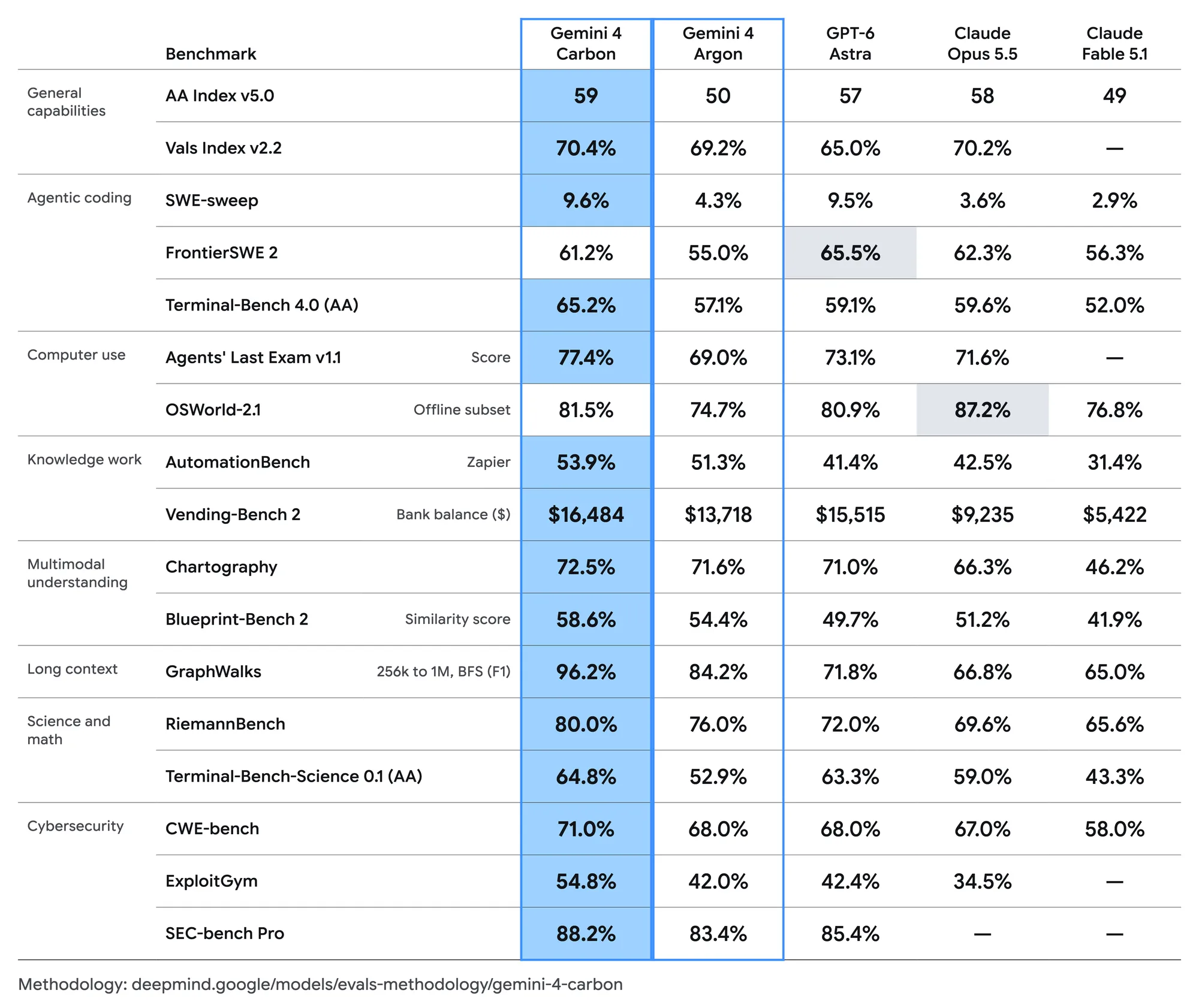
Carbon is designed for tasks that push a model's limits: code migrations affecting multiple packages, root cause analysis of failures spanning different systems, architectural redesigns, or open scientific research. It uses more tokens than other models to explore, reason, and verify its own work, so it is best reserved for cases where that effort pays off.
- Knowledge work: synthesizes information from dense documents and data in finance, legal, or operations, and generates spreadsheets, presentations, and reports that follow strict formats.
- Agent-based programming: Run compile-and-verify cycles and visually inspect the generated interface.
- Defensive cybersecurity: According to Google, it leads the way in vulnerability discovery, exploitation, and remediation assessments. Its cybersecurity version is offered to defenders through the Fairwind program. Wiz used it in its "Scan for Good" initiative and discovered zero-day vulnerabilities in two major SaaS providers in less than two hours.
- Science and mathematics: helped generate millions of lines of Lean code to formally prove security properties of Signal's cryptographic protocol, in weeks rather than years.
In finance, Carbon matched the best model tested in Hebbia’s financial research evaluation and ranked first among 23 frontier model configurations in Balyasny’s financial intelligence benchmark. It is also more honest: in an evaluation involving 375 agent-based tasks, it passed 92% of the tests—compared to 70% for Argon—and refused to fabricate missing experimental data in 98% of cases.
Gemini 4 Neon: frontier-level, faster, and cheaper
Neon is the family's mid-range model and likely the most compelling for most businesses. Google positions it as frontier-level intelligence offering fast end-to-end execution, geared toward complex programming, analytical reasoning, and enterprise production workflows.
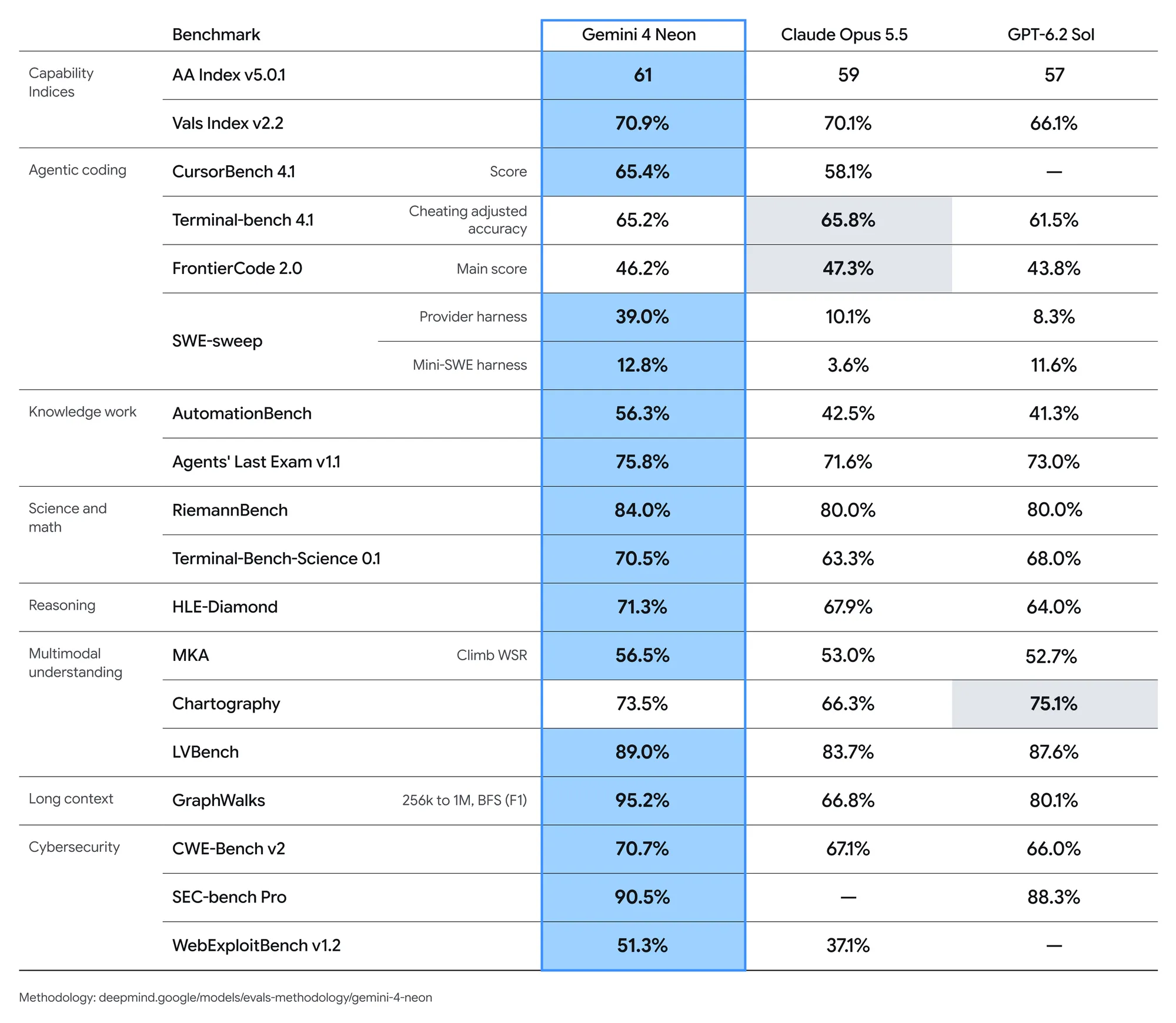
- Best value for money: With its default configuration, it costs 32% less per task than Carbon, according to Google.
- Reliability: Google claims that it is the model with the lowest rate of data fabrication it has measured to date in its internal tests.
- Mixed documents: converts spreadsheets, PDFs, charts, audio, and video into structured deliverables, within a 1-million-token context window.
- Long sessions: It maintains long-running agent flows involving multiple tools and compacts the context to avoid losing the thread.
- More secure code: According to Google, it generates more secure code than Carbon and achieves top-tier results in cybersecurity evaluations at half the cost of large competing models.
According to data published by Google, Neon ranks first on Artificial Analysis's Coding Agent Index, holds third place on its general intelligence index, leads the Legal Research Bench and Tax Agent Bench, and ranks first on Zapier's AutomationBench and Andon Labs' Vending-Bench 2—a long-term business management simulation.
Gemini 4 Hydrogen: the engine for everyday life
Hydrogen is the family's fast and cost-effective model. Google describes it as its go-to model for agent-based workflows and positions it as the successor to the Flash series. It can operate independently or serve as an execution engine alongside Carbon or Argon.
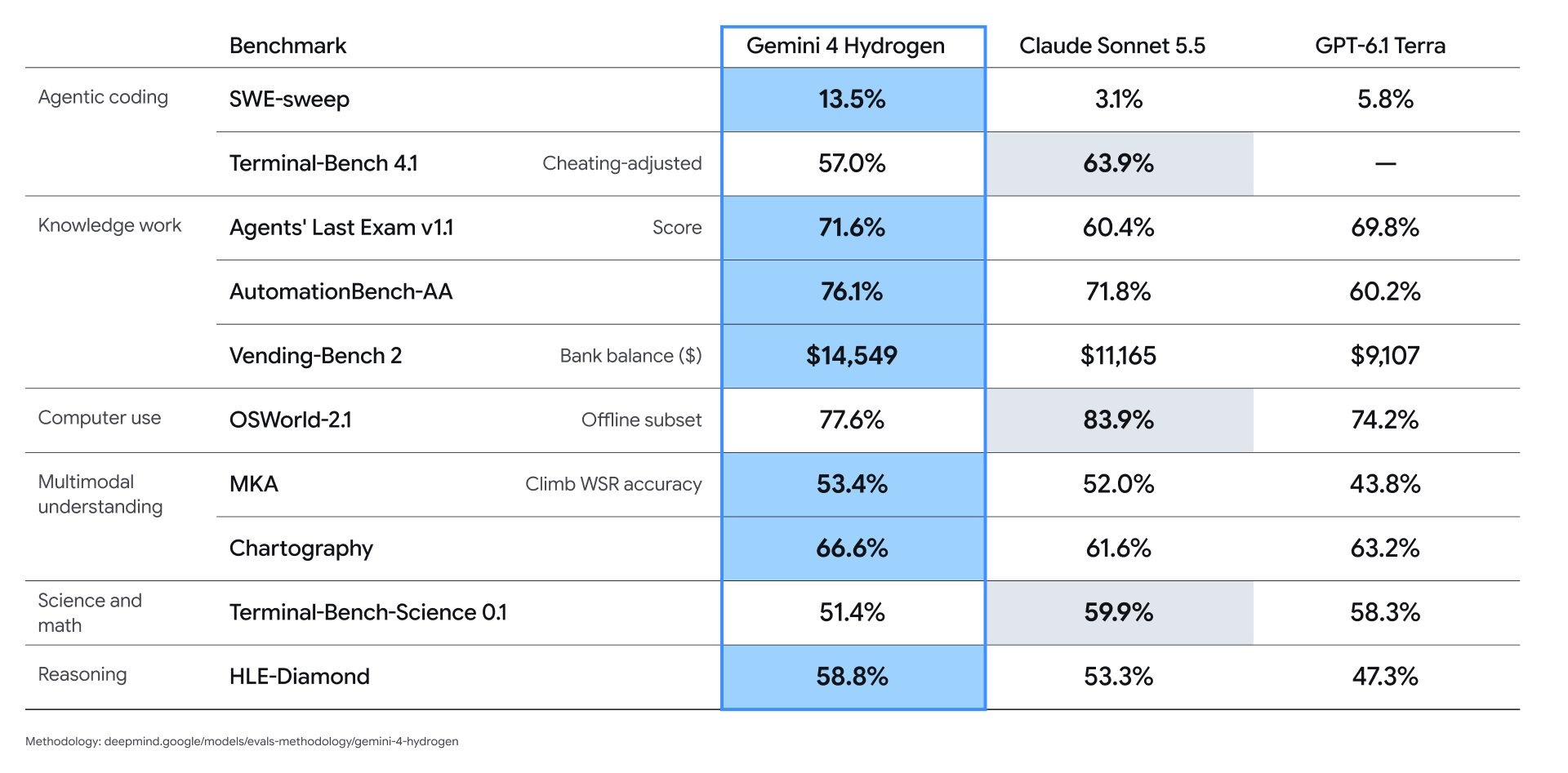
- More intelligence for less: In the Artificial Analysis index, it scores 51 points with its default configuration—one more than Argon—and reaches 54 at its maximum reasoning level.
- Much better than the previous Flash: Compared to Gemini 3.8 Flash, it completes tasks about 2.5 times faster, improves from 18.2% to 57% on Terminal-Bench 4.1, and reduces fabricated claims by more than fivefold.
- Professional work: It ranks number 1 in Vals' Tax Agent Bench (52.3%) and ties for first place in its Legal Research Bench (55.8%).
- Large context at a flat rate: supports up to 1 million input and output tokens, with the same price across the entire context window.
- Integrated into Google Workspace: Gemini for Google Sheets generates scenario-based financial models more than 30% faster than previous models.
Google partners who tested it prior to launch—using graph flows, SQL, and data-intensive workloads—saw execution speeds 2 to 2.8 times faster and token consumption reduced by 12% to 23%.
How they work together: the model that thinks and the model that executes
The most practical innovation lies not in any single model, but in combining them. In Google Antigravity—the development environment featuring Google agents—an orchestrator mode switches between Carbon and Hydrogen within the same session. In Terminal-Bench 4.0, it achieved a success rate close to that of Carbon while using 24% less quota on average and finishing 19% faster.
The pattern is the same with Neon: the frontier model coordinates, divides the work, and verifies the result, while multiple agents powered by Hydrogen execute tasks in parallel. For a company, this translates into a simple rule: there is no need to pay the price of the most powerful model at every step of a process—only for those steps that truly require it.
Which model to choose based on your situation
| If you need… | Recommended model |
|---|---|
| Customer service, classification, summarization, data extraction, or high-volume automation | Gemini 4 Hydrogen |
| Agents that execute many specific tasks within a broader workflow | Gemini 4 Hydrogen |
| Financial, legal, or tax analysis; reports based on mixed-format documents; and complex programming. | Gemini 4 Neon |
| Agents who plan and supervise the work of other agents | Gemini 4 Neon or Carbon |
| Long-term, critical projects, such as architecture migrations, research, or code security audits. | Gemini 4 Carbon |
Neon and Hydrogen also feature four reasoning levels, allowing the model's "thinking" to be adjusted based on the difficulty of each task—and, consequently, the associated cost.
Where they can be used
The three models are arriving via the usual channels of the Google ecosystem:
| Where | For whom | How |
|---|---|---|
| Gemini Enterprise | Employees and business teams | Model selector or API, depending on your organization's configuration |
| Gemini Enterprise Agent Platform | Technical teams building agents and applications | General Availability (GA) with the identifiers , and gemini-4-hydrogen |
| Gemini API, Google AI Studio, and Google Antigravity | Developers | Carbon and Neon at the paid tier; Hydrogen at all tiers. |
On Agent Platform, the three models are available at the global endpoint and in the US and European Union multi-regions, with a context window of 1,048,576 tokens. You can view the specifications in the Gemini Enterprise Agent Platform model documentation.
How much do they cost?
API access is billed based on token usage. These are the list prices published by Google in its announcements:
| Model | Input (per million tokens) | Output (per million tokens) |
|---|---|---|
| Gemini 4 Carbon (introductory price, until November 30, 2026) | 2 USD | 10 USD |
| Gemini 4 Carbon (standard price, effective December 1, 2026) | 4 USD | 20 USD |
| Gemini 4 Neon | 3 USD (0.15 USD with cache) | 15 USD |
| Gemini 4 Hydrogen | 1.50 USD | 7.50 USD |
For Gemini Enterprise, which is licensed on a per-user basis, Google does not specify in its announcements which editions and quotas include each model, so it is advisable to verify this before preparing a quote.
Three recommendations for controlling spending:
- Start with Hydrogen: It handles most tasks at a fraction of the cost, and upgrading to a higher-end model is only worth it when the quality falls short.
- Use your head when reasoning: Higher reasoning levels improve quality but consume more tokens. Adjust them according to the task type.
- Measure the cost per task, not per token: A more expensive model that solves the problem on the first try can end up being cheaper than a low-cost one that requires multiple attempts and constant supervision.
⚠️
Note: Prices are subject to change and do not include taxes. Always consult the official Google Cloud pricing page before sizing a project.
Safety and reliability
Google has focused on ensuring these models are reliable when acting as agents, which is where the greatest risk lies for a company:
- Carbon blocked 99% of attempts by an attacking agent in simulated cyberattack tests and yielded no new universal jailbreaks across more than 13,000 test prompts.
- Neon It maintains the same protections as Carbon against misuse and instruction injection but rejects fewer legitimate tasks, and it recorded a 0% success rate for indirect injection attacks on the Gray Swan benchmark at its highest reasoning level.
- Hydrogen reduces by up to 81% the instances where an agent goes beyond what was requested, and cuts misaligned actions or shortcuts in programming and tool-use tasks by up to 12-fold.
This is particularly important if you plan to connect agents to your email, document management system, or web sources: the injection of hidden instructions within that content is a major concern for security teams.
Things to consider before adopting them
Validate using your own cases
All the benchmarks in this article are published by Google or its partners, and it is Google that chooses which evaluations to report. They serve as a good reference, but before deploying a model to production, compare it with the one you currently use across a representative set of your tasks, measuring quality, time, and cost.
Data residency
In Agent Platform, all three models are available in the European Union multi-region. If your organization needs to keep data in Europe, configure your projects and data sources in that multi-region. Documentation for Carbon and Neon also indicates that they are available to verified enterprise customers in specific regions, so it is advisable to confirm access for your project.
Review your current workflows
If you are already working with Gemini 4 Argon or earlier Flash models, there is no need to change everything. Review which workflows would benefit from Neon in terms of cost and speed, and which ones can move to Hydrogen without a loss in quality. As always, switch the model in production only after testing it.
European AI Regulation
If an agent based on these models interacts with people or generates content, the transparency obligation under the... already applies. European AI Regulation. Incorporates transparency and human oversight into critical processes from the outset.
How The Cloud Collective helps you
At The Cloud Collective, Google Cloud Premier Partner, we work exclusively with the Google ecosystem. Leveraging the full Gemini 4 family, we help companies:
- Select the appropriate model for each use case and design workflows that combine a frontier model with Hydrogen to optimize costs.
- Expand Gemini Enterprise so that business teams use these models from day one.
- Build agents on the Gemini Enterprise Agent Platform, securely connected to your data and deployed in the European Union.
- Govern security, including protection against prompt injection and compliance with the European AI Act.
- Measure and optimize consumption-based costs so the project can scale without billing surprises.
Conclusion
With Carbon, Neon, and Hydrogen, Google rounds out the Gemini 4 family, designed to work as a team: one model for the most demanding tasks, another offering the best balance between intelligence and cost, and a fast one for day-to-day operations. For businesses, the opportunity lies not in choosing the most powerful model, but in matching each task with the right one. That is the deciding factor between a cost-effective AI project and one where costs spiral out of control.